UNC Water & Health Conference 2026
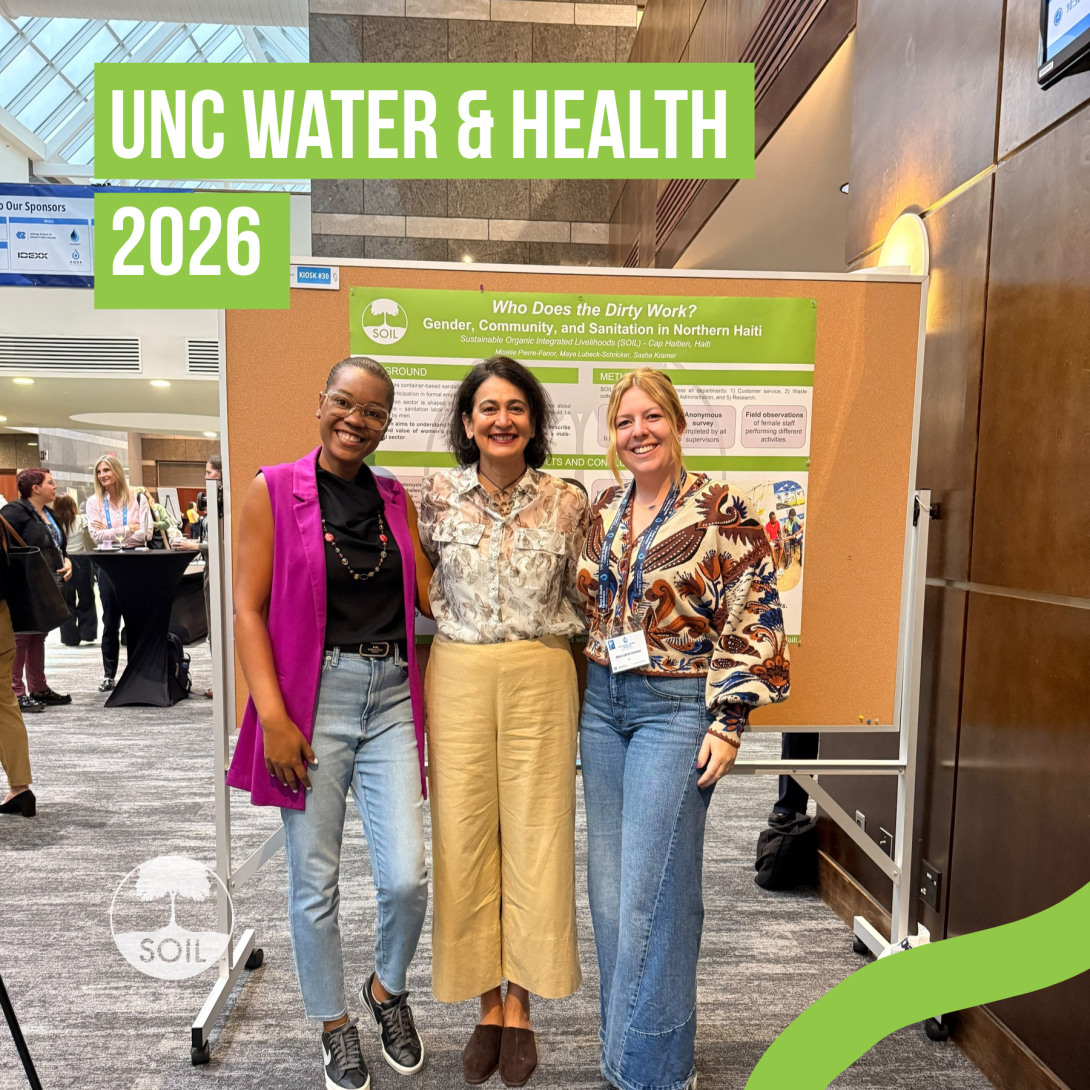
Miselie Pierre-Fanor, Tanvi Nagpal, and Maya Lubeck-Schricker at the 2026 UNC Water and Health conference in Chapel Hill, North Carolina.
Last week, SOIL’s research team traveled to Chapel Hill, North Carolina, for the 2026 UNC Water & Health Conference. It is the largest international conference held each year that focuses only on water, sanitation, hygiene (WaSH), and health. Maya Lubeck-Schricker, Director of Research and Innovation, and Miselie Pierre-Fanor, Research Project Manager, presented new findings from our work in northern Haiti across three sessions. They also tested the questions that will shape our next phase of research and learned from colleagues across the sector.
Financing what works: Lessons from results-based financing
The week opened on Monday with a side session, “From Promise to Practice: Lessons from Results-Based Financing for Water & Sanitation Services.” SOIL joined four other organizations at different stages of designing and implementing results-based financing (RBF). Together they offered an honest look across contexts at what is working, what isn’t, and what the sector still needs to figure out.
SOIL’s practical experience contributed key takeaways for the audience, including leveraging RBF to unlock government funds. On January 20, 2026, SOIL and DINEPA, Haiti’s National Directorate for Drinking Water and Sanitation, signed the first government-funded RBF contract for container-based, off-grid sanitation services delivered as an ongoing public service. Under that contract, public funds are released only after sanitation outcomes have been independently verified, creating pathways to long-term public sector financing for sanitation.
From survey to pilot: Keeping EkoLakay affordable
On Monday afternoon, Miselie gave a verbal presentation titled “From Survey to Pilot: Developing a Targeted Subsidy Program for Container-Based Sanitation in Haiti.” She explained how SOIL moved from household survey data to a targeted discount for EkoLakay, our household container-based sanitation service.
The service discount pilot launched on October 1. It aims to help families who are struggling to pay for basic services keep their EkoLakay subscription at an affordable monthly rate, so that a household does not lose access to safe sanitation when money gets tight.
In December 2015, the UN General Assembly adopted a resolution which states that everyone is entitled to sanitation that is “physical and affordable” and that provides privacy and dignity. As SOIL works to uphold human rights in Haiti, targeted discounts is one practical way to make affordability real for the households that need it most while keeping EkoLakay as a paid and professional service, deliberately shifting away from an NGO model and towards operating as a public provider.
Who does the dirty work?
On Thursday, Miselie presented a poster titled “Who Does the Dirty Work? Gender, Community, and Sanitation in Northern Haiti.” The poster asked how the people who run SOIL’s container-based service describe the role and value of women’s work in a male-dominated sector. The findings draw from focus group discussions conducted by our Research Team. Women working in sanitation face stigma and stereotypes every day. One participant described how this reaches into her family:
“Our children’s classmates tell them that their moms work in poop, and that hurts them.”
Another participant described a change she has seen:
“I was the only woman in collection work when I started working here, now there’s another one.”
This stigma is not unique to Haiti. A 2019 study by the World Bank, ILO, WaterAid, and WHO found that sanitation workers are too often invisible, uncounted, and ostracized, and that many of their challenges come from this lack of recognition.
Understanding stigma and how it appears in everyday life is the first step to changing it. Sharing women’s experiences and contributions can encourage others to join the sector and can help shape policies that promote dignity, safety, and fair working conditions. For SOIL, this research guides how we support our team. It helps us build respect for sanitation work across northern Haiti and make sure our team has the equipment, knowledge, and support they need to do their jobs with pride.
Sanitation is essential infrastructure. A healthy society is built on it, and it works because people show up to do it every day. From sanitation workers to trash collection drivers to sewage treatment plant workers, thank you to everyone doing the work that keeps our families and environment safe and clean.
Thank you to our friends and partners who joined us in Chapel Hill. We look forward to continuing these conversations.