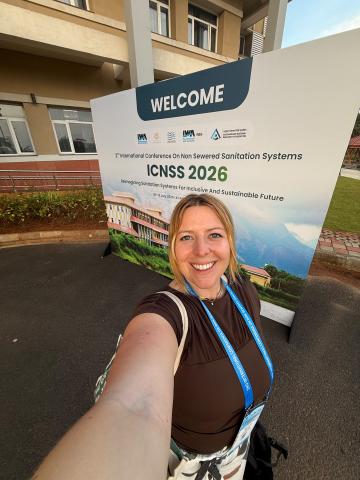
SOIL attends 2nd International Conference on Non-Sewered Sanitation
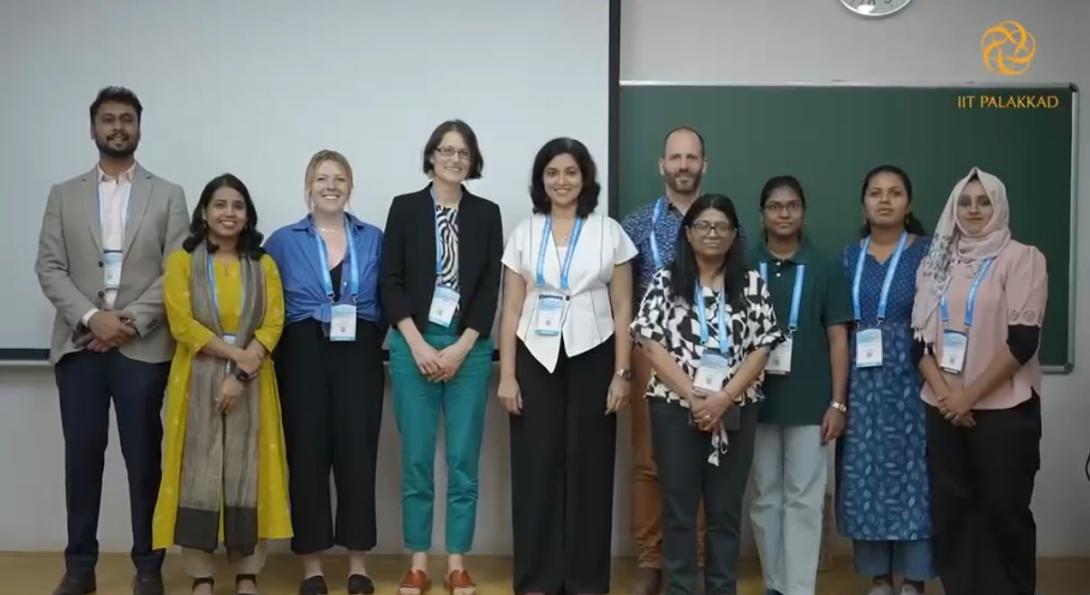
Maya and other NSS (non-sewered sanitation) practitioners at the conference.
Across three days of keynotes, panels, and technical sessions, the 2nd International Conference on Non-Sewered Sanitation kept returning to one core reframe: non-sewered sanitation (NSS) is no longer a debate about whether it’s legitimate — it’s now about how to make it affordable and scale it.
Sunita Narain, Director General at the Centre for Science and the Environment, gave an opening keynote that set the tone, arguing modernity in sanitation doesn’t require underground sewers but rather systems that intercept and treat waste wherever it is generated. Narain pushed for treating on-site systems as the reality to regulate rather than a problem to eliminate, with capacity utilization of existing treatment plants (often running below 20%) and reuse of treated water/biosolids as the two biggest levers.
A related thread ran through nearly every panel: technology is not the bottleneck anymore — the enabling environment is bylaws, procurement systems, financing pathways, government capacity, and clear legal responsibility for sanitation, not just sewers and toilets.
Citywide Inclusive Sanitation (CWIS) emerged as the dominant organizing framework, with a dedicated session reporting it’s widely accepted in principle but unevenly implemented and strongest where it aligns with existing governance, though the model is still lacking documented evidence of impact.
Several presenters also pushed against rigid sewered/non-sewered or household/centralized binaries in favor of mixed, area-based technology decisions driven by context (topography, density, terrain) — reinforced by decision-support tools like the Portuguese multi-criteria model and India’s rapid-assessment, GIS-based methodologies.
On technology and evidence: the Gates Foundation’s 15-year Reinvent the Toilet effort has proven circular, water-efficient household and community systems are technically viable (ISO 30500 certification, several fielded systems in China, Korea, India), but cost and willingness-to-pay remain the binding constraint, prompting a strategic pivot toward demonstrating performance and lowering price points in higher-income proving ground markets.
Financing and business models were repeatedly flagged as the real gap to universal sanitation access—with multiple speakers noting that sanitation subsidies are unavoidable for the poorest neighborhoods, that banks funding only CapEx (capital expenditures) breaks NSS business models, and that scaling sanitation systems requires blended/risk financing and government procurement pathways, not NGO funding alone.
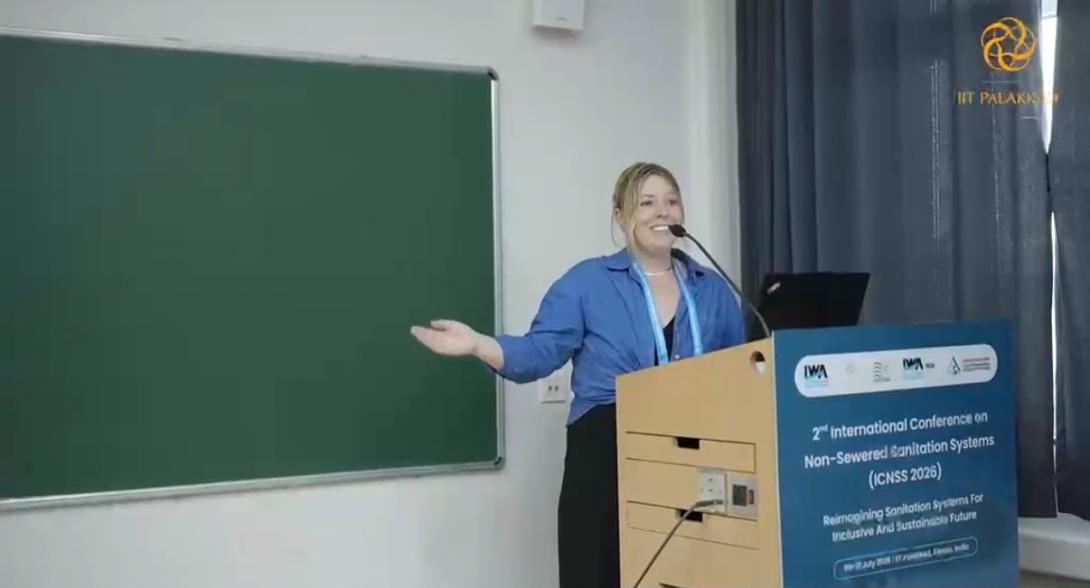
We were proud to have our Research and Innovation Director, Maya Lubeck-Schricker, represent SOIL at the conference and bring home an award for best oral presentation at the conference - way to represent our work in Haiti on the global stage!