Understanding Who Lacks Safe Sanitation — and Why?
What does it take to expand safe sanitation to the most vulnerable communities? Before we can answer that question, we need to understand where people stand today — who has access, who doesn't, and what's getting in the way. For SOIL, this kind of baseline knowledge isn't just academic. It's the foundation for designing services that are equitable, financially sustainable, and genuinely responsive to community needs.
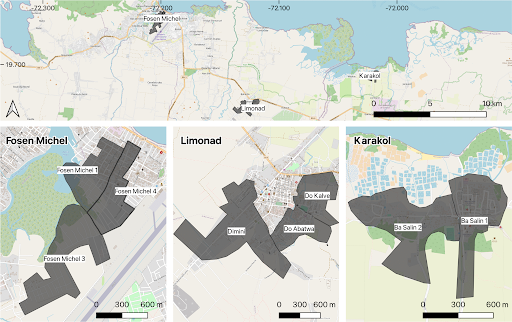
A recent peer-reviewed study conducted by SOIL’s Research Team in collaboration with the Aquaya Institute was published in PLOS Water and presents findings from a large-scale baseline survey of sanitation access and satisfaction in three communities in northern Haiti. The survey was conducted as part of SOIL's results-based financing (RBF) pilot with the Inter-American Development Bank Lab's Outcomes for Change Fund — an innovative financing model in which funds are disbursed only upon verified achievement of pre-defined sanitation targets. To measure progress, our team first needed a clear picture of the starting point.
Key Research Findings
- Safe sanitation remains out of reach for many households in northern Haiti. Across 4,008 surveyed households in three communities, 19% reported practicing open defecation — consistent with national estimates. This figure varied dramatically by neighborhood, from just 5% in Limonad to more than 51% in Karakol, reflecting the uneven distribution of sanitation access even within a single region.
- Cost is the primary barrier to private toilet ownership. Among households without a private toilet, prohibitively high upfront costs were the most commonly cited reason — particularly among the poorest households. Over a third of surveyed households (38%) fell into the poorest wealth quintile, while only 4% were in the wealthiest. This underscores that affordability, not motivation, is often the central obstacle to improved sanitation access.
- Poverty and neighbors' behaviors are both strong predictors of open defecation. Statistical analysis confirmed that poorer households had significantly higher odds of practicing open defecation. Equally striking, a household's own sanitation behaviors were closely tied to those of its neighbors: for each additional 1% of neighbors practicing open defecation, a household's own odds of doing so increased meaningfully. This suggests that social norms and community context — not just individual circumstances — shape sanitation outcomes.
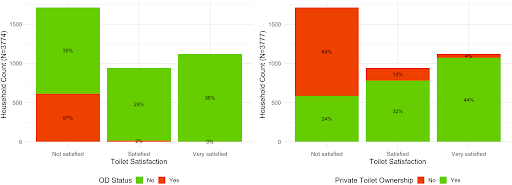
Dissatisfaction with sanitation is widespread, even among those with a toilet. Nearly a quarter of households that already owned a private toilet reported being unsatisfied with their current sanitation. This points to a significant unmet demand for sanitation options that go beyond basic access — services that offer dignity, privacy, and reliability. For SOIL, this is both a challenge and an opportunity.
This research speaks to something that guides SOIL's approach in a fundamental way: expanding sanitation coverage requires more than building toilets. It requires understanding the economic realities, social dynamics, and unmet aspirations of the communities we serve. By grounding our results-based financing pilot in rigorous baseline data, we can track real progress, target resources more effectively, and make the case to funders and policymakers that evidence-based sanitation investment delivers results.