Interview with SOIL’s New Research Consultant, Jean Bernard
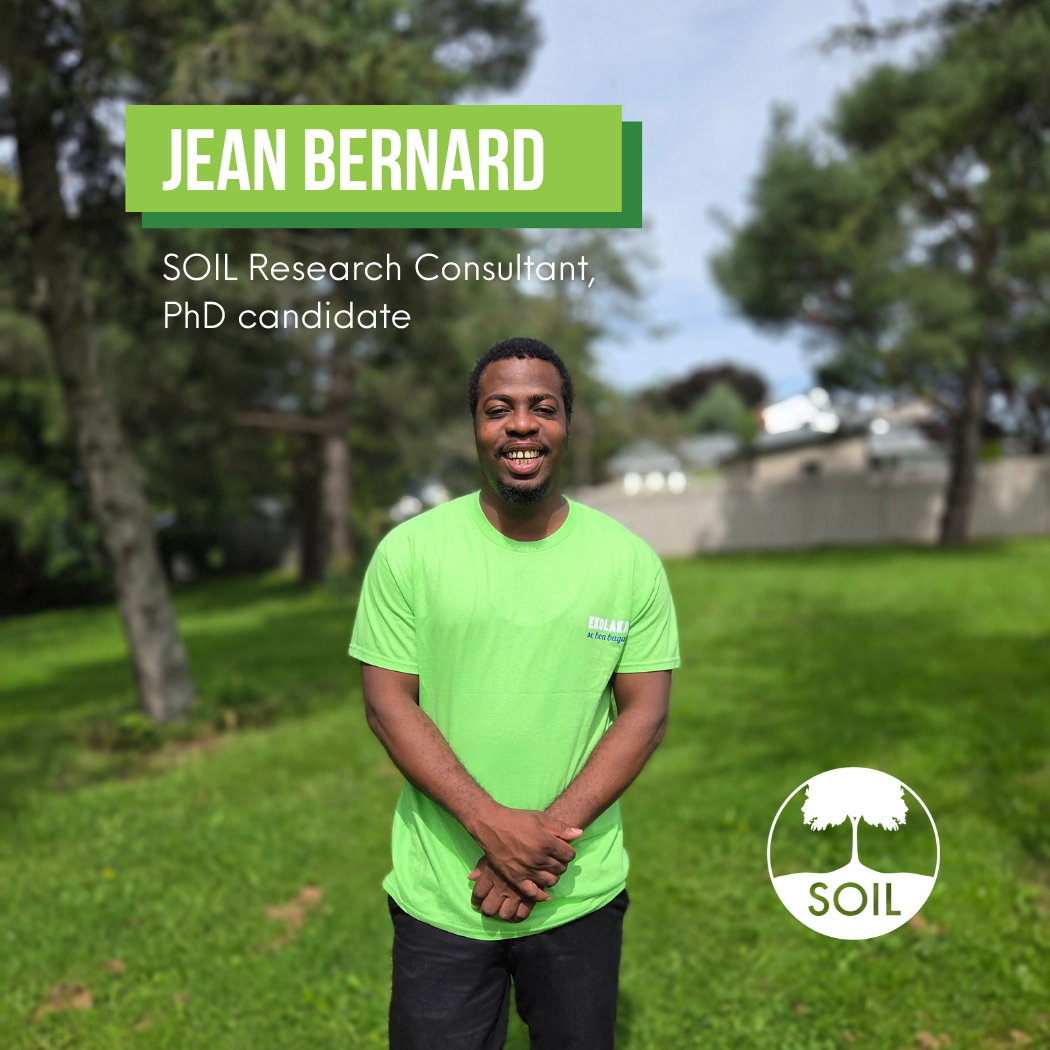
Jean Bernard Durone joined SOIL this year as an IT and Research Consultant, bringing with him extensive training in agronomy and data analysis. A UHELP alumn, Jean Bernard is now pursuing his PhD in Canada. We spoke with him about his work, SOIL’s partnership with UHELP, and his broader vision for the future of agriculture and sanitation in Haiti.
Tell us about yourself and your studies.
I'm an agronomist by training. I began my studies in Haiti at Université Quisqueya, where I studied agronomy. I then went to France and completed a master's in the same field. I've always loved anything to do with data, so I did a second master's in data analysis, also in France. Now I'm in Canada pursuing my doctorate in a field related to agricultural intelligence.
What drew you to SOIL?
SOIL's work in Haiti, transforming toilet waste into compost, addresses a very real problem. In many parts of the country, people don't have access to toilets, which has severe consequences for the environment and pollutes the water people drink. But SOIL doesn't only solve an environmental problem. That waste collected in the sanitation service also becomes compost, which is one of the most important inputs in agriculture. As an agronomist and as a Haitian, this is what motivated me to join the team.
You recently spent three weeks with the team in Tilari and Mouchinette. What was that experience like?
It was truly extraordinary. In Tilari and Mouchinette, I found colleagues who were ready and available to help me. I was new to the role, and there were things I didn't know yet. I could always ask questions that helped me understand and move my work forward.
What stayed with me most was the way everyone works together, across different activities on site and across every department. I was also happy to take part in the work from start to finish, from waste collection all the way to the finished compost at Mouchinette. Now that I'm away, I stay in touch with the team through Slack, email, and WhatsApp. I keep learning from them, and they learn from me too.
Many SOIL managers have come through the UHELP program. As a UHELP alumnus yourself, why do you think the partnership works so well?
As scholars, we gain skills not only at university but through the UHELP network, which, alongside paying our tuition, trains us in computer skills, leadership, and English. SOIL gives us the chance to put our professional skills into practice while we're still in university.
Many UHELP students share SOIL's philosophy. Through the program, we take part in projects related to sanitation and community cleanup, so we arrive to SOIL with a foundation in this kind of work.
How do you see young Haitian professionals, at home and abroad, contributing to the country's foundations?
If we want to build a stronger Haiti, training young people is one of the most important ways to get there. Through UHELP, we not only develop leadership skills within ourselves, but we also learn to form leadership in others around us. Not every young person in Haiti has the chance to enter UHELP or university, so part of our role as leaders is helping to train those citizens and make the skillsets and knowledge accessible. When students struggle to finish their thesis or final project, we can accompany them and keep moving forward.
Those of us who come out of UHELP as agronomists, managers and engineers can bring our skills together to approach complex problems in a more effective way.
As a systems thinker, what is your hope for the future of Haiti's agriculture and sanitation sectors, and how do you see SOIL's work contributing?
In the agriculture sector, I hope SOIL becomes a source of organic fertilizer for all of Haiti. Studies show that chemical fertilizers can have negative consequences for the people who use them, and people don't always know how to apply them or at what dose. Compost made from properly treated waste has far less impact on human health and on waterways. I hope SOIL continues to be the reference in Haiti for this ecological sanitation model, and that farmers across the country can use SOIL's compost to improve soil fertility. With good land and good compost, Haiti can feed itself and become self-reliant in agriculture.
Why is SOIL's work important to you personally?
Sanitation is a real problem in Haiti, not only in rural areas but even in Port-au-Prince and other large cities. Sometimes people don't have the means to build a toilet, or the toilets they do have fill up with waste quickly. SOIL is working to solve this, and the results are already concrete: the number of people who benefit from the EkoLakay service, the number of toilets, and the amount of compost produced. The impact is real and continuous.
Research is the other part that interests me, since I'm doing my doctorate. SOIL has a dynamic research team with real integrity, and I'm lucky to be in constant communication with them. SOIL carries out operational research for its own work, but also research that contributes to the advancement of science.
Is there anything else you'd like to add?
Whenever I talk with colleagues or others around SOIL, I could go on for a long time, because honestly, of all the organizations I've worked with, SOIL is one I truly love being part of.